Development
The clan, or “clann” meaning children, emerged as a kin-based social structure mostly during the Middle Ages, specifically between the 11th and 14th centuries. Some historians suggest that by the time of the Battle of Culloden, the clan system may have already existed for a millennium.1 Tracing clan lineage before the 13th century is extremely challenging. It is important to note that kin-based systems were found worldwide and were not exclusive to the Scottish Highlands.
The rise of the clan system was driven more by political upheaval than by ethnic factors. In the 12th and 13th centuries, the Scottish Crown seized control of Argyll and the Outer Hebrides from the Norsemen and suppressed the Mormaer of Moray. The suppression of several northern rebellions allowed warlords who supported the crown to establish dominance over local families, who accepted their protection. These warrior chiefs were primarily Celtic, though their origins ranged from Gaelic to Norse-Gaelic and British backgrounds.
By the 14th century, additional kindred groups, including those of Norman or Anglo-Norman descent such as Clan Chisholm and Clan Fraser, had joined the clan system.2 During the Wars of Scottish Independence, Robert the Bruce introduced feudal tenures, awarding charters for land to harness the loyalty and military capability of the clans for the national cause against the English.
Membership
The relationship between the clan chief and members was built on mutual responsibilities and obligations. Land was occupied based on the principle of duthchas, meaning collective heritage. The chief provided protection and distributed land among followers, while members recognized his authority and that of the leading gentry. Members were also required to provide military service when necessary.
Not everyone bearing a clan’s name was a direct descendant of the chief. Many clansmen, though unrelated, took the chief’s surname to show solidarity, gain protection, or secure sustenance.
Structure
The top of the clan hierarchy was occupied by the fine, or clan elite, consisting of the chief and leading gentry—close relatives and heads of cadet families. Disputes among clan members were resolved at this level, and under the system of Heritable Jurisdictions, clan chiefs, as landowners, presided over private justice courts for most legal matters, except high treason.
Beneath the elite were the doine-uasile, or lesser gentry, including the tacksmen (fir-tacsa), who held large leases from the chief and sublet them to tenants. Tacksmen were often related to the elite. They managed the fair distribution of runrigs—long strips of arable land separated by uncultivated runs—and handled the annual sale of black cattle for their tenants. In times of conflict, tacksmen served as clan officers, organizing and leading the fighting men into battle.
Tenants endured insecurity of tenure, with leases as short as a single year and subject to the tacksman’s decisions. Tenant farmers often sublet portions of their leases, resulting in smaller holdings and widespread poverty, with most people living at subsistence levels.
Lands
Clan estates consisted of small townships -the bailtean – each with a few hectares of arable land (about 20%) and pasture (about 80%). Only 9% of Highland land was suitable for cultivation. Upland grazing areas, or shielings, were also associated with townships. Arable land was divided into strips, or rigs, and periodically re-allocated, preventing any tenant from permanent access to the best land. Most farms operated under joint tenancies, with only the tenants’ names recorded; sub-tenants or cottars, who exchanged labour for small plots, were not documented.
The principal crops were oats, bere (a type of barley), and sometimes wheat or rye, depending on local conditions. Livestock included economically important cattle, as well as horses, goats, and small Highland sheep. Meal often had to be imported. During summer, livestock were moved to shielings to allow lowland pasture to recover and protect unfenced arable land.
The mid-18th century saw the introduction of the potato, which rapidly became the staple diet of many Highlanders. However, this reliance on a single food source would ultimately lead to disaster a century later.
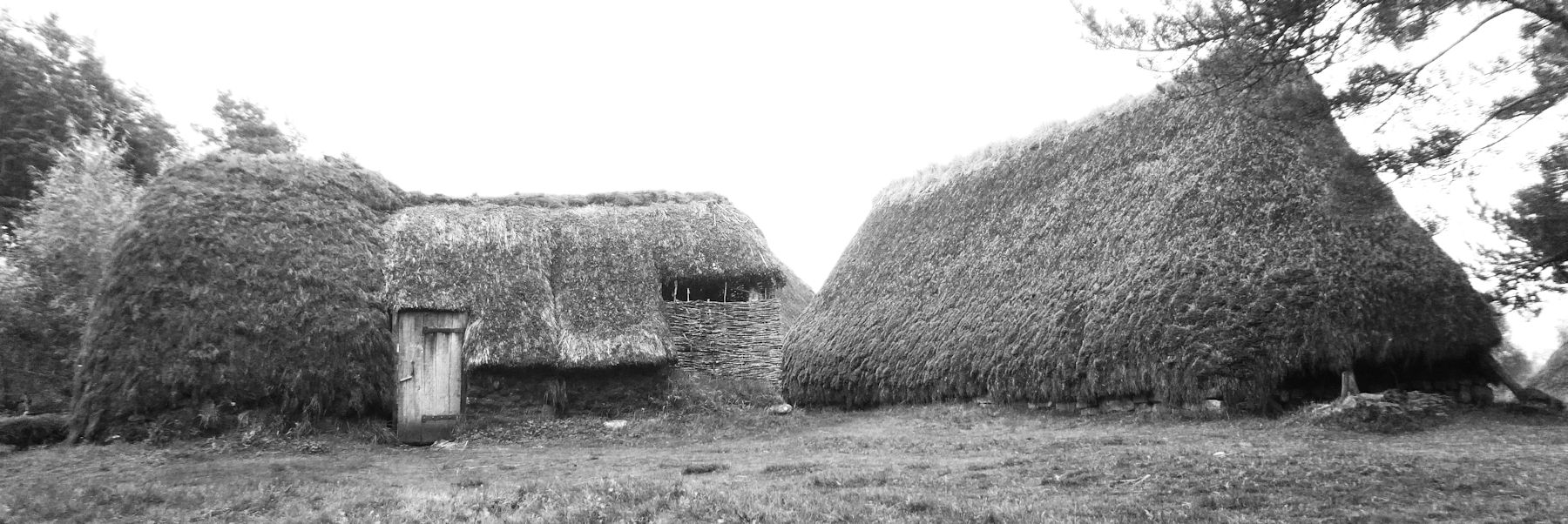
Houses within townships were basic, even for some gentry, though their homes tended to be larger. Commonly used materials included stone, turf, wood, and thatch, with wood in high demand—roof timbers were sometimes relocated if a tenant moved. By the 19th century, stone became increasingly popular as a building material.
Rents
Until the early 1700s, rents were typically paid through labour, services, and produce—known as victual rents. Payments included livestock, poultry, and possibly designated days for shearing sheep or felling timber. Cash payments were rare. Over time, as landlords became more commercially minded, cash became a larger component of rent payments.
1 Hunter J. ‘A Dance Called America’ p.38
2 MacKenzie A. ‘History of the Chisholms’ (1893) and ‘History of the Frasers’(1896)